Beyond the Surface: Mercury's Enormous Iron Core and Density Secrets
In the vast expanse of our solar system, few celestial bodies capture the imagination quite like Mercury. It's often overshadowed by its more flamboyant planetary neighbors, yet this smallest and innermost planet holds secrets that challenge our understanding of planetary formation. While its extreme environment and rapid journey around our star are well-known, it's what lies beneath Mercury's pockmarked surface – an enormous iron core – that truly sets it apart, revealing a story of surprising density for such a tiny world.
To comprehend Mercury's unique composition, one must first appreciate its singular position. Like Mercury's orbit around the Sun, its very existence is defined by its proximity to our star, shaping everything from its desolate landscape to its fundamental structure. This article delves into the fascinating paradox of Mercury: a planet that is both the smallest and the second densest in our solar system, all thanks to a heart of heavy metal.
A World Forged in Fire: Mercury's Extreme Environment
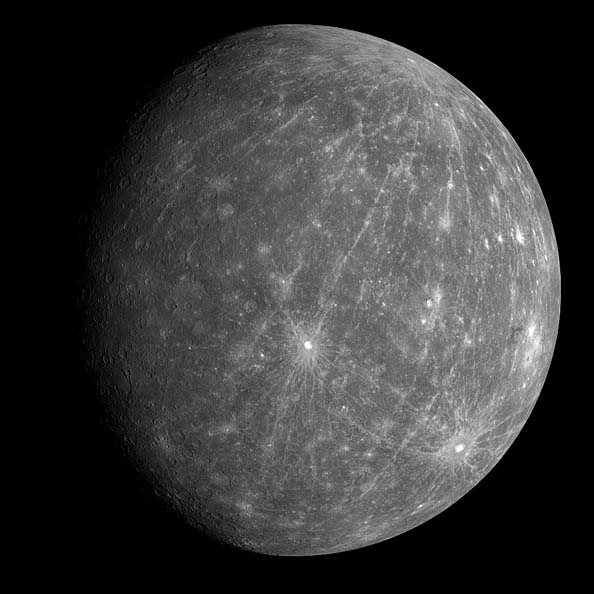
Mercury is indeed a world of extremes. Positioned at an average distance of just 58 million kilometers (0.4 AU) from the Sun, it endures a relentless solar onslaught. This close proximity means it has virtually no atmosphere to speak of, offering no protection from the Sun's intense radiation and leading to the most drastic temperature swings in the solar system. Daytime temperatures can soar to a scorching 430°C (800°F), hot enough to melt lead, while the long, 59-Earth-day nights plunge to a frigid -180°C (-290°F).
The planet's slow rotation – taking 59 Earth days to spin once, yet only 88 Earth days to complete an orbit – results in a sunrise-to-sunrise cycle lasting an astonishing 176 Earth days. This means vast stretches of Mercury's surface are baked for months at a time, further emphasizing the harsh conditions directly influenced by like Mercury's orbit around the Sun. With no active volcanism to renew its surface, Mercury is a heavily cratered testament to billions of years of cosmic bombardment, a stark reminder of its estimated 4.5-billion-year history as a 'dead world.'
Despite its formidable conditions, Mercury's size is modest. With a radius of 2,440 km (1,516 mi), it's only about one-third the size of Earth and even smaller than some moons in our solar system, such as Ganymede and Titan. This makes it the smallest of the major planets by a significant margin. Yet, its relatively small stature belies a profound secret hidden deep within its interior.
The Heart of the Matter: Unpacking Mercury's Enormous Iron Core
This is where Mercury truly astonishes scientists. While many planets possess an iron core, Mercury’s is disproportionately massive. Geologists and planetary scientists believe its metallic core spans an incredible 85% of the planet's entire radius. To put that into perspective, Earth's core makes up roughly 55% of its radius, and its volume is only about 17% of the planet's total. Mercury’s core, on the other hand, comprises roughly 42% of its total volume, an astounding proportion for any planet.
This immense iron heart presents a significant puzzle for planetary formation theories. How did such a small planet end up with such a dominant metallic core? Several hypotheses attempt to explain this anomaly:
- Giant Impact Hypothesis: One leading theory suggests that early in its history, Mercury may have suffered a colossal impact with another large celestial body. This catastrophic collision could have stripped away much of Mercury's lighter silicate mantle, leaving behind a planet primarily composed of its heavy, iron-rich core.
- Evaporation Hypothesis: Another idea posits that Mercury formed closer to the hot, young Sun than it is today. The intense heat would have vaporized lighter rocky materials, leaving behind only the heavier, more refractory elements like iron to condense and form the planet.
- Solar Drag Hypothesis: A third theory proposes that during its formation, particles of different sizes were differentially dragged by the Sun's solar wind. Lighter silicate particles might have been preferentially blown away, while heavier iron particles remained to accrete into Mercury.
Understanding the sheer scale of Mercury's core is crucial not just for its internal structure but also for its surprisingly weak, global magnetic field. While Earth's magnetic field is generated by a convection of liquid iron in its outer core, Mercury's large core likely features a similar dynamic, albeit on a different scale, allowing it to generate a magnetosphere that, despite its weakness, still deflects solar winds.
Density Deception: Why the Smallest Planet is So Heavy
Despite being the lightest planet in the solar system, with a mass of 3.3011 × 10²³ kg (only 0.055 times Earth's mass), Mercury holds a surprising distinction: it is the second densest planet, just behind Earth. This paradox—lightest yet densest—is almost entirely attributable to its colossal iron core.
Density is a measure of mass per unit volume. For Mercury, while its total mass is relatively low, its volume is even smaller, and a significant portion of that volume is occupied by extremely dense materials, primarily iron. Consider its average density: approximately 5.43 grams per cubic centimeter (g/cm³). Earth, with its much larger mass, boasts an average density of 5.51 g/cm³. This narrow difference highlights just how exceptionally dense Mercury is for its size. The high iron content within its interior effectively packs a tremendous amount of mass into its small volume.
This remarkable density further supports the theories of its formation, suggesting a planetary history that prioritized the retention of heavier elements. The composition influenced by processes like Mercury's orbit around the Sun, where materials were sorted by heat and gravitational forces, appears to have resulted in a planet that is a true heavyweight among its peers, despite its outwardly diminutive appearance. It's a testament to how fundamental physical laws govern planetary evolution and create such unique celestial bodies.
Speed and Eccentricity: The Dynamics of Mercury's Journey
Beyond its internal composition, Mercury's orbital characteristics are equally compelling. Its status as the closest planet to the Sun directly dictates its incredible speed. Gravitational forces dictate that planets closer to their star must orbit faster to maintain their path. Consequently, Mercury is the fastest planet in our solar system, whizzing around the Sun at an astonishing average speed of 47.87 km/s (107,082 mph). This makes Neptune's leisurely 5.43 km/s seem glacial by comparison.
But Mercury's orbit isn't just fast; it's also the most eccentric (elliptical) of all the solar system's planets, with an eccentricity of 0.2056. This means its distance from the Sun varies significantly throughout its 88-day year, ranging from 46 million kilometers at perihelion (closest approach) to 70 million kilometers at aphelion (farthest point). This highly elliptical path causes variations in the solar radiation it receives, further contributing to its extreme environment.
Observations, like those captured by the European Space Agency's Solar Orbiter, vividly illustrate Mercury's dynamic journey. These stunning images show Mercury appearing to pass close by the Sun, allowing scientists to study the planet's interaction with different layers of the solar atmosphere. For a deeper dive into the mechanics and unique features of its path, explore Decoding Mercury's Orbit: The Sun's Closest and Fastest Companion.
The interplay of its rapid, eccentric orbit and its position relative to the Sun creates a visual spectacle that reminds us of the profound gravitational ballet performed by celestial bodies.
In conclusion, Mercury stands as a testament to the diverse and often surprising nature of planetary science. From its desolate, cratered surface to its extreme temperatures and incredibly short year, every aspect of Mercury is intrinsically linked to its challenging position in the inner solar system. Yet, it is the revelation of its enormous, iron-rich core that truly defines this enigmatic world, making it the second densest planet despite its small size and modest mass. This heavyweight heart nestled within a tiny body continues to challenge scientific theories, prompting us to look beyond the obvious. As we continue to explore and analyze data from missions, Mercury remains a captivating subject, full of secrets waiting to be fully uncovered. For more insights into this remarkable world, check out Mercury: Unveiling the Solar System's Smallest & Fastest Planet.